

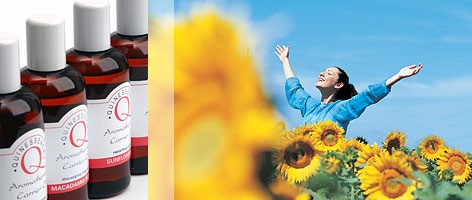
What are Carrier Oils?
Before essential oils can be used in aromatherapy they must be diluted in a 'carrier', since they are too powerful to use neat. Whilst there are other carriers such as base lotions that can be used to dilute essential oils for aromatherapy treatments, carrier oils are the most commonly used medium due to their versatility.
Carrier oils provide the necessary lubrication to allow the hands to move freely over the skin and not 'drag' whilst massaging, whilst at the same time carrying the essential oils into the body. They must be light and non-sticky for this penetration to take place effectively, and preferably have very little odour.
See the complete range of Quinessence Carrier Oils.
Significant role to play
Carrier oils play a far more significant role in aromatherapy than many people realise, and in comparison to the essential oils some people feel they are of little importance. To believe this would be a mistake though, because they offer a wealth of health-giving benefits of their own.
They contain vitamins, minerals and essential fatty acids, and many of them soften and improve the condition of the skin. Some of them are also highly effective in treating irritated, sensitive conditions such as eczema and psoriasis as well as helping to reduce wrinkles and scar tissue. And in case you hadn't already done the mathematics; carrier oils make up 98% of a typical aromatherapy treatment. Think about it.
Technically classed as 'fixed' oils because they do not evaporate, carrier oils are also known as base oils and vegetable oils. They are largely derived from nuts and seeds, although there are a few exceptions to this generalisation. For example, coconut oil is extracted by a special process from the white flesh which is known as 'copra', and jojoba oil is extracted from a leathery-leaved shrub and is actually a liquid wax rather than an oil.
Extraction methods
The oil obtained from nuts and seeds is usually extracted by one of two different methods. The first process is known as 'cold pressing' and is restricted to relatively small scale production these days due to the higher cost. The nuts or seeds are placed in a horizontal press with a rotating screw known as an 'expeller' and the oil is literally squeezed out. Despite the processing name, a certain amount of heat is produced during the process due to friction, but this rarely exceeds 70° or 80° C and causes little damage to the oil. The oil is then filtered and sold as a finished product.
Large scale industrial production uses a method called 'hot extraction' and uses a similar process, but tremendous heat is applied during the process to increase the yield of oil, and temperatures used can reach up to 200° C which destroys the important vitamins and fatty acids. The waste product from both methods of extraction, known as 'cake' is often re-processed using solvents to extract even more oil. This oil is re-heated again, refined, deodorised and the colour is bleached out. Finally, artificial colour, preservatives and vitamins are added back.
These highly refined, solvent extracted oils usually end up on supermarket shelves for use in cooking and are therefore totally unsuitable to use in aromatherapy. All the vitamins, minerals and fatty acids have been destroyed during the extraction process and they are a 'dead' product. You should always buy cold pressed oils for aromatherapy and your skin will be sure to feel the benefits. Regrettably, grapeseed oil can not be produced by cold pressing since a realistic yield of oil can not be produced without applying heat.
Refined or unrefined?
Some oils like Avocado, Coconut and Wheatgerm are available in both a 'refined' and 'unrefined' form, and where you have the choice you should always choose the unrefined oil. Unrefined Coconut oil is impossible to use since it sets like butter, and is therefore made available in the form of a 'fractionated' oil and is very useful in aromatherapy.
Unrefined Avocado oil is a dark green colour and has a very strong odour which is not to everyone's liking, but nonetheless is rich in lecithin and vitamins A and D. Likewise unrefined Wheatgerm oil is a dark orange colour with a strong fragrance typical of the cereal, and contains high levels of essential fatty acids and some vitamin E.
The cosmetics industry prefers refined oils since the darker colours and heavy odours can have an adverse effect on the final product. Because of this, unrefined oils are often only produced in much smaller quantities and can be a little more difficult to find - especially if you only buy from health shops. Fortunately, most reputable aromatherapy stockists will normally offer a selection of unrefined, cold pressed vegetable oils.
How to choose a carrier oil
There is a wide range of carrier oils to choose from, plus some other infused or macerated oils such as Calendula and St Johns Wort. The variety of vegetable oils available to a newcomer can seem a little bewildering at first, since there is very little written on this important subject in many books. But choosing which one is for you is not really complicated at all.
Choosing a carrier oil is exactly the same as choosing an essential oil really, - you choose one with the properties that you need for your particular needs. You just need to know some basic facts about the properties, actions and viscosity of vegetable oils, and then choosing becomes easier. Our simple reference chart below will help get you started.
All of these vegetable oils are the very finest that you can use for intensive facial treatments and body massage, and they can be combined to suit your particular requirements. Experiment with your oils until you find what works best for you - that's one of the keys to success with aromatherapy.
Sweet Almond, Peach and Apricot oils are highly versatile and can be used for both body massage and facial treatments since they are light and easily absorbed. If you are concerned about the possibility of nut-allergy reactions then Sunflower is a perfect body oil since it is extracted from seeds, and the same applies to Grapeseed.
Black Seed, Borage, Evening Primrose, Jojoba and Rosehip oils all deliver outstanding results in facial treatments, but may need diluting with another lighter oil if you want to use them in body massage. None of these oils are extracted from nuts either.
Unrefined Avocado and Wheatgerm are perfect for nourishing the skin in an overnight treatment, but are a little too heavy to use in body massage. They have a strong odour that some people do not like, but please don't let that put you off! They are excellent, deep nourishing oils that will provide essential fatty acids and nutrients to soften your skin.
If you want to use these richer oils in body massage or facial treatments just add them to a lighter oil such as Almond, Apricot or Peach oil at around 15-20%, - then you can enjoy all their therapeutic benefits without the odour. Of course you can do the same with any of the other deep-nourishing oils - and it helps keep the cost per treatment down too.
To complete your massage or facial oil simply add 1 drop of pure essential oil to every 5mls of carrier oil that you use. If you are having a facial treatment remember to avoid the delicate under-eye area and don't apply too much oil - a little goes a long way. Gently work the oil into the skin until it has all been absorbed, and your skin will be left feeling soft and silky smooth.
Copyright © Quinessence Aromatherapy Ltd 2002. Written by Geoff Lyth
If you enjoyed this article, please click the 'Like' button and help spread the word:
Next About Hydrosols
See also Quinessence Carrier Oil Range